From Industry News to Ready-to-Post Drafts, Automatically
The AI Content Engine is a Next.js web app that watches AI-industry news, turns each story into LinkedIn and social-media drafts, and places them in a queue where a person reviews, edits and publishes. It was built to take the sourcing-and-drafting grind out of a consistent posting schedule while keeping a human in charge of what goes out.
The challenge
What was manual, slow or missing
Posting consistently about a fast-moving industry is a two-part job, and both parts are tedious. First someone has to find what is worth talking about — scanning feeds, newsletters and announcements every morning. Then they have to turn a headline into a post that sounds like them, in the right length and format for each platform. For a founder or a small marketing team that is easily an hour a day, and it is the first thing dropped when client work gets busy.
The brief was to automate the sourcing and first-draft stages without automating the judgment. Fully automatic posting was ruled out from the start: an AI-written take on a breaking story needs a person to check facts and tone before it goes out under someone's name. What was needed was a pipeline that delivers a steady stream of drafts already tied to current news, plus a simple queue where each one can be approved, rewritten or thrown away.
The solution
What TaimurTools built
We built the engine as a Next.js application with a scheduled ingestion step that pulls recent AI-industry news from configured sources. Each incoming story is passed to a language model with a platform-specific brief — LinkedIn posts get a longer, opinion-led structure, short-form social drafts get a tighter hook — and the outputs are stored as draft items linked back to the source article.
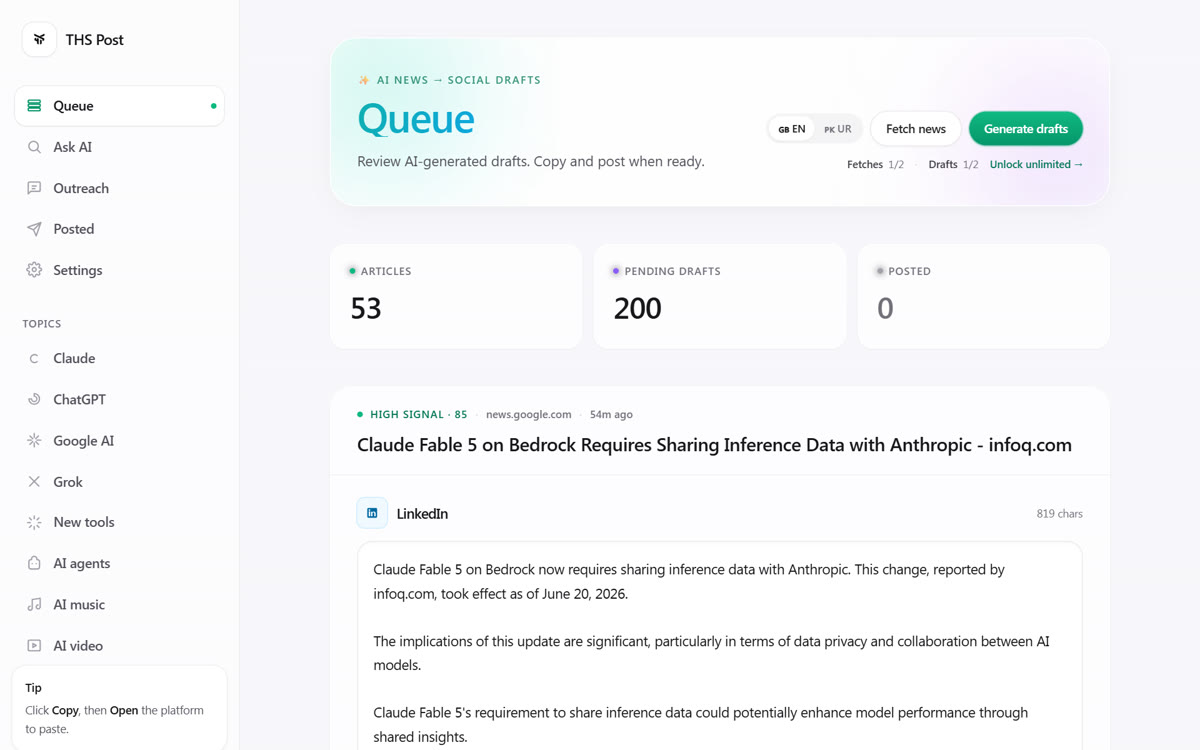
Those drafts appear in a review-and-publish queue inside the app. Each card shows the original story, the generated copy per platform and three plain actions: edit inline, approve, or discard. Nothing leaves the queue without a person moving it, which keeps the workflow honest and gives the reviewer a place to tighten voice over time by adjusting the generation brief.
Next.js was the right base because the same project hosts the scheduled fetch-and-generate routes alongside the queue interface, and it deploys to Vercel with no separate server to maintain. The pattern — ingest, generate, queue, human approval — is the one we reuse for clients who want product updates, blog summaries or customer FAQs turned into publishable drafts.
How it works
How the pipeline works
A scheduled job pulls recent AI-industry stories from the configured sources. Nobody scans feeds each morning.
Each story goes to a language model with a platform-specific brief: a longer, opinion-led LinkedIn draft and a tighter short-form version.
Drafts appear as cards with the source article attached, so the reviewer can check facts and tone before approving.
Nothing is published on its own. A person moves each draft out of the queue.
Voice, length and angle live in an editable brief, so the output improves as the account's style settles.
Key features
What's inside
Automated news ingestion
Pulls recent AI-industry stories from configured sources on a schedule, so nobody has to go looking.
Platform-specific drafts
Generates a LinkedIn version and a short-form social version from each story, each in its own format.
Review-and-publish queue
Every draft waits for a person to edit, approve or discard it — nothing is posted on its own.
Source attached to every draft
Each card keeps the original article linked so the reviewer can check facts before approving.
Adjustable generation brief
Voice, length and angle live in a brief the reviewer can tune as the account's style settles.
Business outcome
What changed
Outcome: Sourcing and first drafts, previously a daily manual routine, now arrive automatically in a review queue. The person's time goes to judgment (fact-check, tone, approval) instead of hunting for stories.
- Sourcing and drafting removed from the daily routine
- Every draft traceable to its source article
- Human approval kept on every post
Outcome figures for this engagement are not published. Verified client metrics are added only with a source and written approval.
Technology
Built with
Services used: AI Agent Development, AI Workflow Automation, Custom AI Development
Need something similar?
Tell us what you are building. We will show you how a similar system would work for your business, then send a fixed-fee proposal.