One Dashboard, Four AI Agents: Inside THS Automation
THS Automation is an AI automation workspace where four specialized agents — Support, Marketing, Operations and Autopilot — draft replies and run routine tasks from a single dashboard. It runs on Next.js with GPT-4o and was built to show what everyday business automation looks like when the agents sit in one place instead of scattered across tools.
The challenge
What was manual, slow or missing
Most small businesses that try AI end up with it in pieces: a chat window in one tab, a prompt library in a document, an automation scenario in another tool, and no shared view of what the AI did today. Each piece helps a little, but nobody owns the whole picture, and the people doing the work still copy text between systems by hand.
The brief for THS Automation was to design a workspace that treats AI agents as staff with defined jobs rather than as a general-purpose chat box. Support, marketing and operations work each have their own inputs, tone and guardrails, and a busy owner needs to see drafts, approve them and hand off repetitive tasks without learning four separate interfaces. The product also had to demonstrate a human-in-the-loop model — agents propose, people decide — because that is the pattern clients are willing to trust with their customers.
The solution
What TaimurTools built
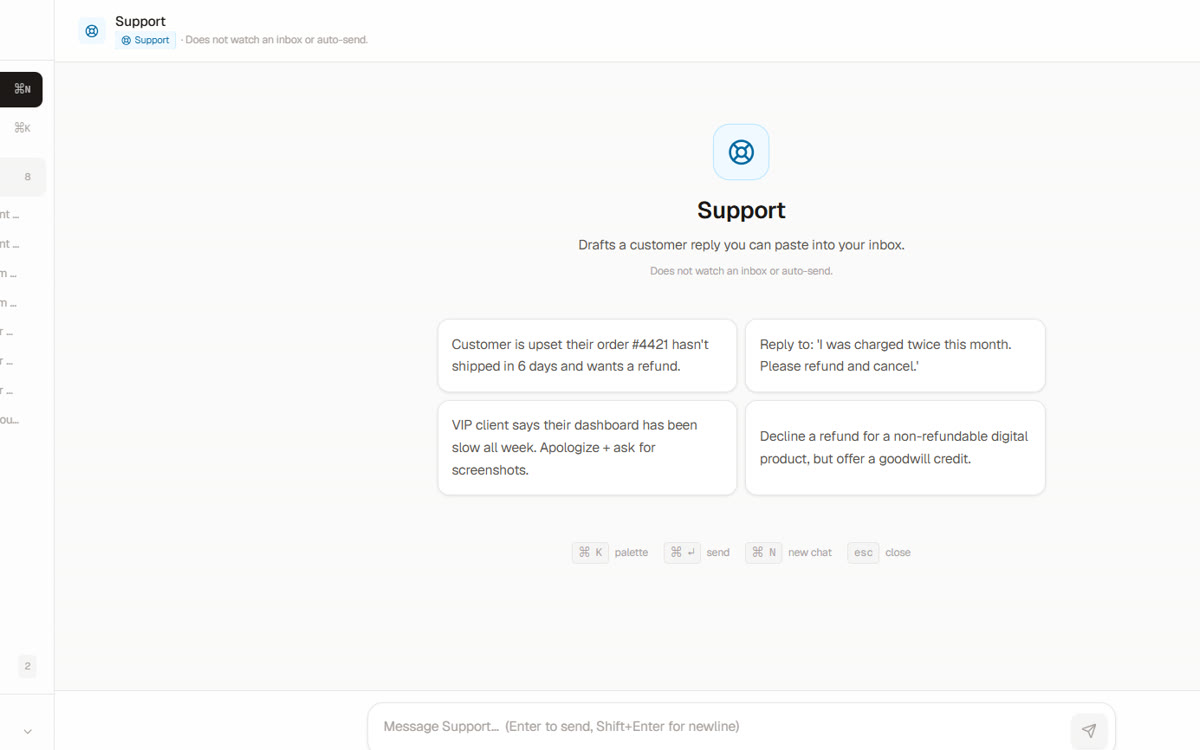
We built THS Automation as a Next.js web application with GPT-4o behind every agent. Each agent is defined by its role. The Support agent drafts customer replies from the incoming message and whatever context it is given. The Marketing agent produces campaign copy, post ideas and email drafts. The Operations agent handles internal work such as summaries, checklists and follow-ups. The Autopilot agent chains routine actions together so a multi-step job can run from a single instruction.
All four live in one dashboard. A user picks an agent, gives it a task or pastes in a message, and reviews the result in the same view — edit, approve or discard. Role-specific system prompts keep each agent on task and in the right voice, and the shared interface means the owner never leaves the workspace to move between support, marketing and operations work.
Next.js was chosen because API routes sit beside the interface, which keeps model calls on the server and the OpenAI key out of the browser, and because its component model makes adding a fifth or sixth agent a configuration change rather than a rebuild. The same architecture is what we adapt when a client wants agents connected to their own inbox, CRM or store.
How it works
How the workspace works
Support, Marketing, Operations or Autopilot. Each has its own role, instructions and guardrails, so it stays on task and in the right voice.
Paste an incoming message or describe the job. The agent drafts the reply, copy, summary or checklist from that input and any context you provide.
Every draft lands in the same dashboard, where a person edits, approves or discards it before anything goes out.
The Autopilot agent runs multi-step jobs from a single instruction, so repetitive sequences no longer have to be walked through by hand.
Next.js API routes call GPT-4o server-side. The OpenAI key never reaches the browser, and adding a fifth agent is a configuration change.
Key features
What's inside
Support agent
Drafts customer replies from the incoming message and any context you give it, ready to edit and send.
Marketing agent
Produces campaign copy, social post ideas and email drafts in a consistent brand voice.
Operations agent
Handles internal tasks: summaries, checklists, follow-up notes and routine admin drafting.
Autopilot agent
Chains routine steps together so a multi-part job runs from one instruction.
Single review dashboard
Every draft lands in one place where a person edits, approves or discards it before anything goes out.
Role-based prompts
Each agent carries its own instructions and guardrails so it stays on task and in voice.
Business outcome
What changed
Outcome: Scattered AI use (a chat tab, a prompt document, a separate automation tool) became one dashboard where four defined agents draft and a person approves.
- Support, marketing and operations drafting handled from one interface instead of four
- Human-in-the-loop by design: nothing goes out without approval
- New agents added by configuration rather than a rebuild
Outcome figures for this engagement are not published. Verified client metrics are added only with a source and written approval.
Technology
Built with
Services used: AI Agent Development, AI Assistant Development, AI Workflow Automation
Need something similar?
Tell us what you are building. We will show you how a similar system would work for your business, then send a fixed-fee proposal.