A Complete Ecommerce Storefront for Laptops and Computer Accessories
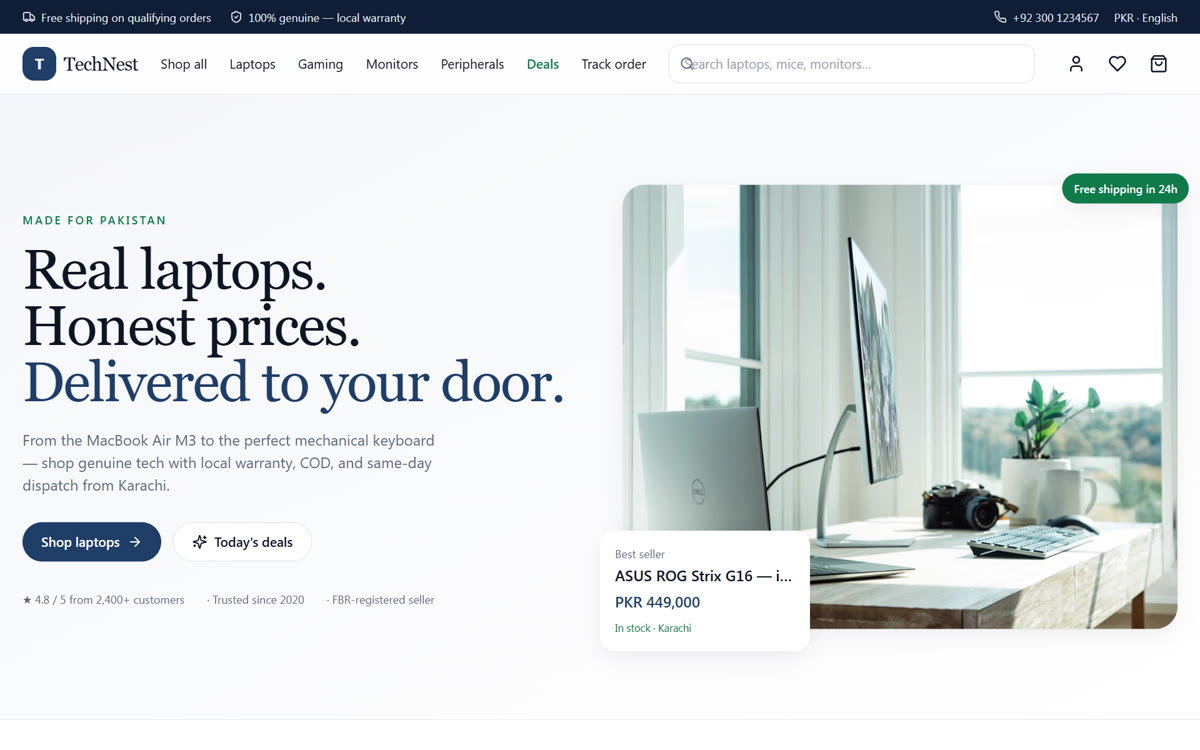
Ecommerce Website by THS is a full storefront for laptops and computer accessories, covering the whole purchase path from product catalog to order tracking. It was built on Next.js 14 with TypeScript and Tailwind so the shop could load fast on any device and grow without a platform rewrite.
The challenge
What was manual, slow or missing
Selling laptops and computer accessories online comes with a specific set of demands. Catalogs are wide and technical — one laptop model may ship in several RAM, storage and color configurations — and shoppers compare specifications closely before they commit. Off-the-shelf store templates tend to flatten that detail into a single product card, which leaves customers guessing and keeps the support inbox busy.
The brief for this build described a retailer that wanted full ownership of its storefront rather than a rented template: a catalog that could handle spec-heavy products, a cart and checkout that felt trustworthy on a phone, and a way for customers to see where an order stood without emailing the shop. It also had to stay fast, because electronics buyers leave slow pages quickly, and it needed to be maintainable by a small team after handover.
Those requirements pointed away from a generic theme and toward a custom, code-owned storefront where every part of the buying journey could be shaped around the products.
The solution
What TaimurTools built
We built the storefront on Next.js 14 with TypeScript across the codebase and Tailwind for styling. Next.js gives catalog and product pages server rendering — which helps both search engines and first-load speed — while the interactive parts (cart, checkout, order status) behave like an app once the page is loaded. TypeScript keeps the product data model honest: variants, prices, stock and order states are typed from end to end, so a schema mistake shows up at build time instead of at the checkout step.
The catalog is organized by category and brand with filterable specifications, and each product page presents variants, pricing and availability clearly. The cart persists between visits, and checkout gathers shipping and payment details in a short, focused flow designed to keep mobile buyers moving. After purchase, customers can look up an order and follow its status from placed to delivered.
Tailwind kept the interface consistent and lightweight, and the component structure means new page types or promotional sections can be added without touching the commerce core. The retailer ends up with a storefront it owns outright and can extend — whether that means connecting order-notification automation, adding a marketplace channel, or moving to a headless commerce backend later.
How it works
How the storefront works
Category and brand navigation with filterable specifications. Each product page shows variants, price and stock where shoppers compare.
Catalog and product pages render on the server for fast first loads and search visibility. Cart, checkout and order status behave like an app once loaded.
The cart survives return visits. Checkout collects shipping and payment in a short flow built for mobile buyers.
Customers look up an order and follow its status from placed to delivered without contacting support.
TypeScript covers products, variants, prices, stock and order states end to end, so data mistakes surface at build time, not at checkout.
Key features
What's inside
Spec-aware product catalog
Category and brand browsing with filterable specifications and clear variant, price and stock display.
Persistent cart
Cart contents survive refreshes and return visits, so shoppers can compare now and finish later.
Focused checkout
A short shipping-and-payment flow designed to keep mobile buyers moving through to confirmation.
Order tracking
Customers look up an order and follow its status from placed to delivered without contacting support.
Server-rendered pages
Catalog and product pages render on the server for fast first loads and search-engine visibility.
Typed commerce model
TypeScript covers products, variants and orders end to end, catching data mistakes at build time.
Business outcome
What changed
Outcome: The retailer owns a storefront shaped around spec-heavy products instead of renting a template that flattened them, with order tracking that removes a class of support emails.
- Full ownership of the storefront code and data model
- Variant, price and stock detail shown where shoppers compare
- Order status self-service instead of email enquiries
- A base that can connect order automation, a marketplace channel or a headless backend later
Outcome figures for this engagement are not published. Verified client metrics are added only with a source and written approval.
Technology
Built with
Services used: Ecommerce Development, Shopify Development, Ecommerce Automation
Need something similar?
Tell us what you are building. We will show you how a similar system would work for your business, then send a fixed-fee proposal.